as Morocco Completes Sixth ‘Wall’
The war in Western Sahara seems to be intensifying as it enters its twelfth year. Last week with four other journalists I was taken by guerrilla troops of the Polisario Front which claims to represent the territory’s Sahrawi inhabitants to watch harassing attacks on the defensive ‘wall’ which Morocco’s 100,000 strong occupying army has built around itself. In broken terrain south of the village of Farsia I was able to clamber inside the double rampart of sand on the night of 14 April. On the night of the 15th, watching from high ground 4km from the wall, I saw the whole northern horizon illuminated by an hour-long barrage of assorted Polisario artillery. Some of the Moroccans’ answering fire, aimed at vehicles passing across the ridge from which we were watching the battle, struck within 200 yards of our position; 152mm shells whistled overhead and exploded in the desert behind us. A large piece of red-hot shrapnel landed nearby.
Late in the morning of the 15th, from two forward observation posts on the rocky bluffs facing the wall, I could clearly see Moroccan vehicles moving between the bases which line the 2,000km-long wall at intervals of 4-10km depending on the terrain. The Polisario moves about freely in the radar ‘shadow’ provided by the broken ground. Piles of artillery cartridges and mortar and shell craters dot the landscape. While we were watching, a Polisario recoilless rifle dropped two shells in the base opposite. Invisible above cloud, a Moroccan jet dropped two bombs a few miles to the east. Several shells, apparently fired at random, exploded in the plain behind us.
Returning to camp for lunch in two Land Rovers, we were fired on twice by a heavy artillery piece probably based 10km behind the wall, along with Moroccan helicopters and sector command headquarters. The shells struck some 300 yards downwind of the vehicles, the second a little closer than the first, when we were in line-of-sight (radar or human) of the Moroccans on the hills to the north. The temporary camp, among the carob trees and fragrant camomile of a river bed 6km south of the wall, was within artillery range but hidden from Moroccan observers. ‘They know we are around, but they do not know exactly where,’ explained front-line sector commander Mustapha Ali.
Five days of rain last November, the first such downpour in a decade, have filled the oueds and sinks of the stony hammada with flowers and ephemeral foliage. But despite the cool spring nights, living conditions in a region the Sahrawis call the ‘line of fear’ are harsh. The nearest well to the camp was 50km away, I was told. The Polisario’s net-draped, sand-coloured open Land Rovers must carry drums of warm, salty desert water in addition to food, weapons and blankets. Everyone sleeps in the open. The guerrillas bake gritty bread at night under the embers of their carob-wood fires, their other staples being tinned sardines, powdered milk and strong, sugary green tea.
Visitors to the front are treated with unforced desert hospitality; mutton and toilet paper were two unusual items produced by our hosts. A 2-foot-long armoured lizard, black with transverse bright yellow bands on its back, was shot through the head with a Kalashnikov and gutted with my penknife before being baked like bread in the embers. But despite our entreaties we were not given a taste. Either the treat was too good to waste on passers-by or the Sahrawis believed that we would not like it.
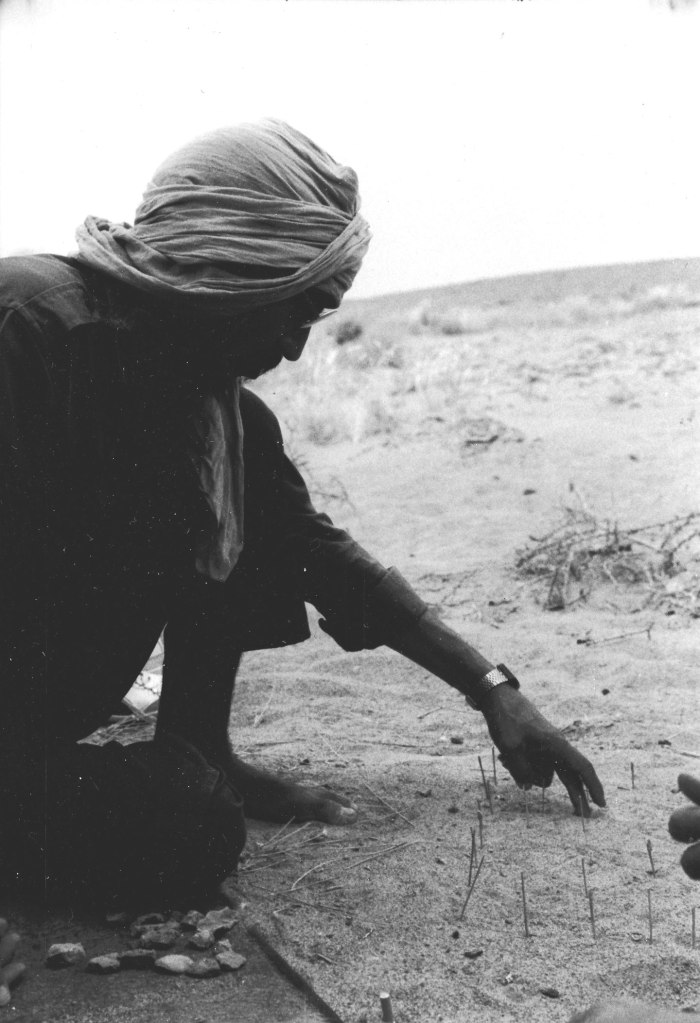
Apart from tea and conversation, the Polisario’s 20,000 men while away the waiting hours of midday with a complicated form of draughts, sticks versus stones, on boards drawn in the sand. They are Muslims but less fussy than some about religion. Some of the troops could be seen discreetly praying at dawn, dusk and midday, but others do not bother. As soldiers on active service they are excused the physically demanding fast of Ramadan which begins in a few days, but I was told that many do observe it.
They are very devoted to their Land Rovers which, like camels, look shabby but are strong, quiet and economical. Most are low-mileage examples tuned for a 30 mph long-range cruising pace. Four-wheel drive is used only for clambering up cliffs and through sand dunes. Close to the enemy at night, they idle along without lights and in virtual silence at walking pace in second gear. For the major frontal attacks meant to overrun the wall, of which there have been half a dozen since 25 February, the Polisario has tracked armoured troop carriers of which we saw many traces in the sector. But these are not shown to visitors and the Polisario does not discuss them, or the tanks whose tracks could also be seen here and there. The same applies to the SAM missiles which keep Morocco’s Mirages and helicopters at a safe distance.
Manning the wall is no joke for the Moroccans. At the Polisario’s rear base south of Tindouf in Algeria, a hundred or so Moroccans captured this year were paraded beside an array of booty which included US-made Dragon anti-tank missiles and French Milan missiles, as well as assorted artillery and small arms. Alongside the 100 or so prisoners was an assortment of military booty including US-made Dragon anti-tank missiles and some of the French Milan missiles which recently made such an impression on the Libyan army in Chad. I spoke to Corporal Lelras el Rhalib Rashid who said that the Sahrawis had penetrated the wall elsewhere and attacked his post from the rear at dawn. Sixteen men had been captured with him near Haouza on 8 April. Two were in hospital, two on stretchers and several others wore medical dressings. Rashid was worried that his family would not know what had become of him.
Morocco’s King Hassan has hedged his bold and ruthless gamble in annexing the former Spanish Sahara by claiming that the Sahrawis are really Moroccans and the Polisario an Algerian mercenary organisation with sinister communist aims. This has won him substantial military aid from France and the US. But the Sahrawis point out that while their SADR is now recognised by nearly 70 countries, not a single state recognises Morocco’s right to their territory and its rich phosphate deposits. They want a UN-supervised referendum to include their 165,000 refugees in the Tindouf camps, but to leave out the military and other Moroccans now in Western Sahara. In the short term, they want the EEC to involve itself in the Moroccan/Spanish fishing agreement now that Spain is a Community member. They say a clause should be inserted in any agreement differentiating Moroccan waters from the even richer offshore fishing of Western Sahara.
While I was in Western Sahara Mauritania issued a statement to the effect that it would not be over-fussy about incursions over its northern frontiers. The vast, underpopulated desert country, which has had good relations with the Sahrawis since its withdrawal from the war in 1978, fears that it may be dragged back into the conflict by the proximity of Morocco’s sixth wall to the railway line between Zouerate and the Atlantic port of Nouadhibou. The railway, which carries Mauritania’s main export, iron ore, runs along the southern frontier of Western Sahara. In places the new wall will be only 300 yards away. Mauritania has a treaty with Algeria, which supports the Polisario Front and its Sahrawi Arab Democratic Republic, so the consequences of a real threat to Mauritania are unpredictable.
April 1987 (early extended draft of a piece for the West African Hotline)
 John Howe: Bricolage: Essays, Journalism and Improvisations